The Hidden Meaning of Dreaming About Taking Exams — A Rehearsal for Anxiety, Preparation, and Growth
You enter the exam hall, only to find unfamiliar papers, a pencil lead that keeps snapping, and time relentlessly slipping away... Sound familiar? Such dreams are often not merely terrifying experiences, but rather the result of stress and tasks from waking life being reworked during sleep. Dreams are reported to be particularly vivid during REM sleep, when emotions and memories are processed. Thus, viewing ‘exam dreams as the mind's signal rehearsing real-life tasks’ can be genuinely helpful.
1) ‘Dreaming of taking an exam unprepared’ — When stress manifests in altered forms
Pressures, deadlines, and evaluation anxieties from daytime often surface in dreams as narratives of “being unprepared”. Experts view this as a phenomenon where current stress combines with intense past scenes (school, exams) and replays them. As ‘exams’ symbolise life evaluations, they are common when facing performance assessments, presentations, or interviews in reality. Breaking down real-life tasks into smaller units and combining them with checklist-rehearsals often reduces dream frequency or lessens emotional intensity.
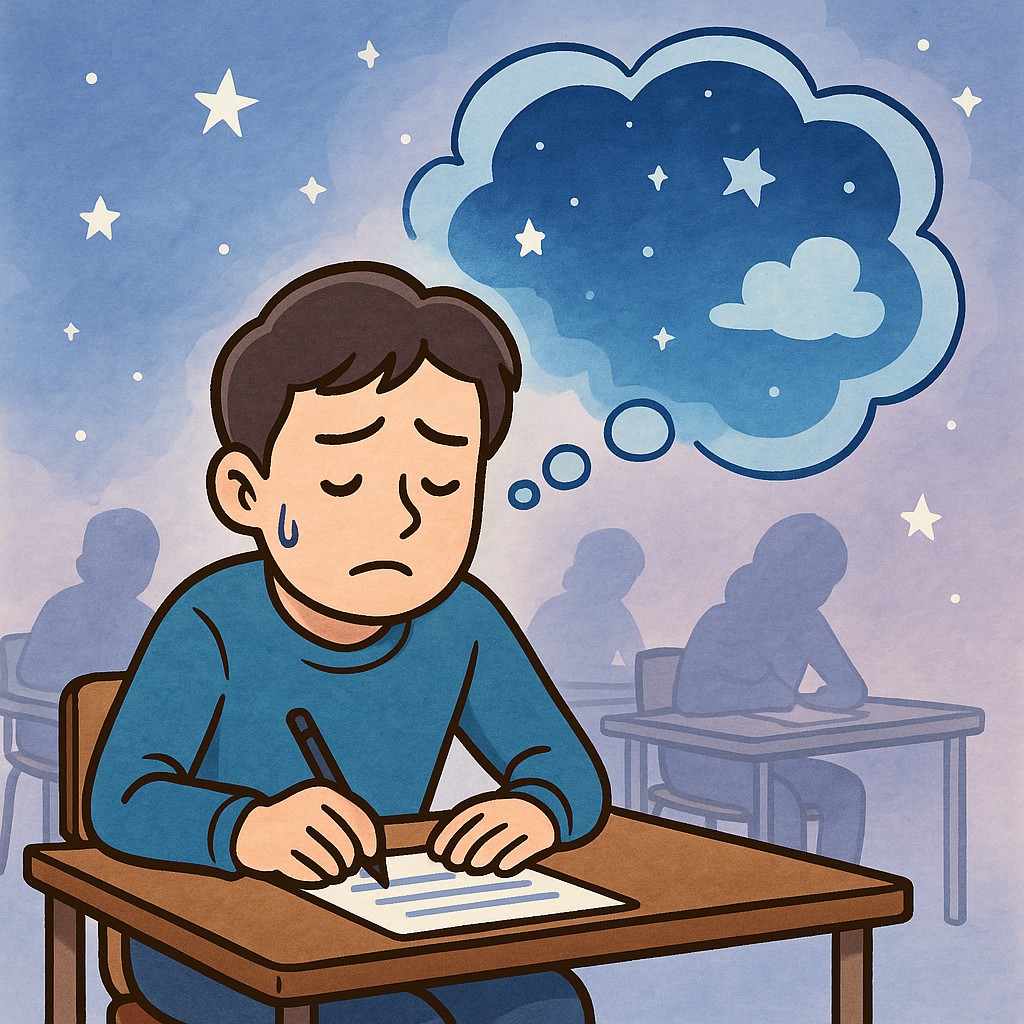
2) ‘Dreams of being late or unable to find the exam venue’ — a signal of reduced sense of control & need for structure
Dreams of wandering through lecture halls or glancing at a clock to realise you're already late often reflect a decline in sense of control. This theme tends to surface more frequently when schedules and information are scattered. In reality, establishing fixed routines (sleep, meal, exercise times) and dashboardising schedules and materials onto a single screen can be helpful. When ‘what to do first’ becomes clear, the dream narrative subsides or becomes less anxious.
3) “The problem is easy, but my body is sluggish? The pencil won’t write?” — Symbol of performance anxiety
Obstacles in dreams (broken calculators, pens that dry out, bodies slowing down) are actually icons of performance anxiety. If such dreams recur, it is advisable to relearn the mind-body connection during waking hours through brief simulated scenarios (timed problem-solving or presentations). While views on sleep's role remain divided, recent research suggests REM sleep tends to weaken concrete memories while aiding the integration of categorical and contextual information. That is, the “core strategy” practised during the day can be organised and generalised at night.

4) ‘Dreams of returning to an old school to take an exam’ — Transition periods and identity checks
It is common even as an adult to have dreams about school or exams. They typically appear during transition periods like a job change, new project, or relationship reassessment, reflecting the inner question: ‘Am I sufficiently prepared?’ Keeping a dream journal to record characters, emotions, and locations, then matching them one-to-one with current life challenges, can yield insights. If recurring nightmares impair sleep quality, try combining sleep hygiene checks with relaxation training (breathing exercises, stretching).
5) ‘Dreams of failing exams or making mistakes’ — When rehearsing failure can be rehearsing success
Interestingly, observations show that groups who dreamt about exams just before the actual test performed better. Interpretations are twofold.
(1) The dream may have facilitated preparation by readjusting emotions and memories, or (2) those deeply immersed in studying may have dreamt more frequently. Either way, the message is clear. Linking dreams to preparation actions yields benefits.
A Reality Routine to Reduce Exam Dreams
- Stabilise Sleep Rhythms: Go to bed and rise at the same time daily. When REM sleep stabilises, dream intensity can also lessen.
- Separate and Organise Emotions and Tasks: Before bed, spend 5 minutes writing down just 3 tasks for tomorrow, then cover up. Signal to your brain that you're ‘in control’.
- Dream journaling and labelling: Jotting down three keywords (emotion, location, action) immediately upon waking reduces unpleasantness and makes understanding the dream easier.
- Daytime stress management: Stress tends to be “integrated” into dreams. Reduce residual arousal during the day with a 10-minute walk or breathing exercises.
Q&A
Q. Are exam dreams a bad omen?
Rather than an omen, they are more likely a reflection of current stress or evaluation situations. Anxiety in dreams can be used as a prompt to ‘enhance preparation and structure’.
Q. Why do I remember them so vividly?
Vivid dreams are typically experienced during REM sleep, where emotional processing is active, leaving clearer memory traces.
Q. Can dreams genuinely impact real-life study or performance?
While debated, recent research suggests REM sleep may be involved in “reconstructing and integrating” memories. Therefore, using dreams as “hints for preparation” rather than “evidence of anxiety” could give you an edge in real situations.


댓글