Eye Health & Vision Protection for Your 40s & 50s: Essential Care Guide for the Digital Era
As we age, presbyopia sets in and vision gradually declines—a very concerning issue. Vision care is one of the most important aspects of health management. While we use smartphones a lot these days, the problem lies less in the ‘screen’ itself and more in exposure time, distance, and habits. Starting today, simply changing your 20-20-20 rule, blinking, distance, lighting, and humidity can make your eyes feel much more comfortable.
Why Do Eyes Feel More Fatigued After Age 40?
- Decreased Accommodation (Onset of Presbyopia): The crystalline lens hardens, making it difficult to focus on close-up text. This is why small smartphone text is particularly tiring.
- Dry Eye Syndrome (Keratoconjunctivitis Sicca): When focusing on screens, blinking frequency drops to 1/3 or less, causing the tear film to evaporate quickly.
- Prolonged close-up work: Staring at objects within 30cm for extended periods causes the ciliary muscle to remain tense, leading to eye fatigue and headaches.
- Environmental factors: Air conditioning/heating, dry indoor air, and strong light contrasts accumulate fatigue.
Digital Device Usage ‘5 Core Principles’
- 20–20–20 Rule: After 20 minutes of work, look at something 20 feet (6m) away for 20 seconds. Shifting focus to the distance relaxes the focusing muscles.
- Distance & Angle: Keep eyes–screen at 50–70cm, with the top of the screen 5–10cm below eye level. Elevate your laptop with a stand and use an external keyboard/mouse.
- Increase font size: Enlarge text and use high-contrast, highly readable fonts. Insisting on small text causes fatigue to increase exponentially.
- Lighting and glare: Avoid backlighting (light shining from behind). Set screen brightness similar to ambient lighting. A matte screen protector also helps reduce glare.
- Blink Training: Along with the 20–20–20 rule, deep blink five times. Keep preservative-free artificial tears on your desk and use 1–2 drops when feeling dry or burning.
Blue Light Note: Strong blue light at night can disrupt your sleep rhythm. Lowering brightness and color temperature (Night Mode) two hours before bedtime and sleep hygieneare the essential solutions. The effectiveness of blue light filter glasses during daytime work varies significantly between individuals.
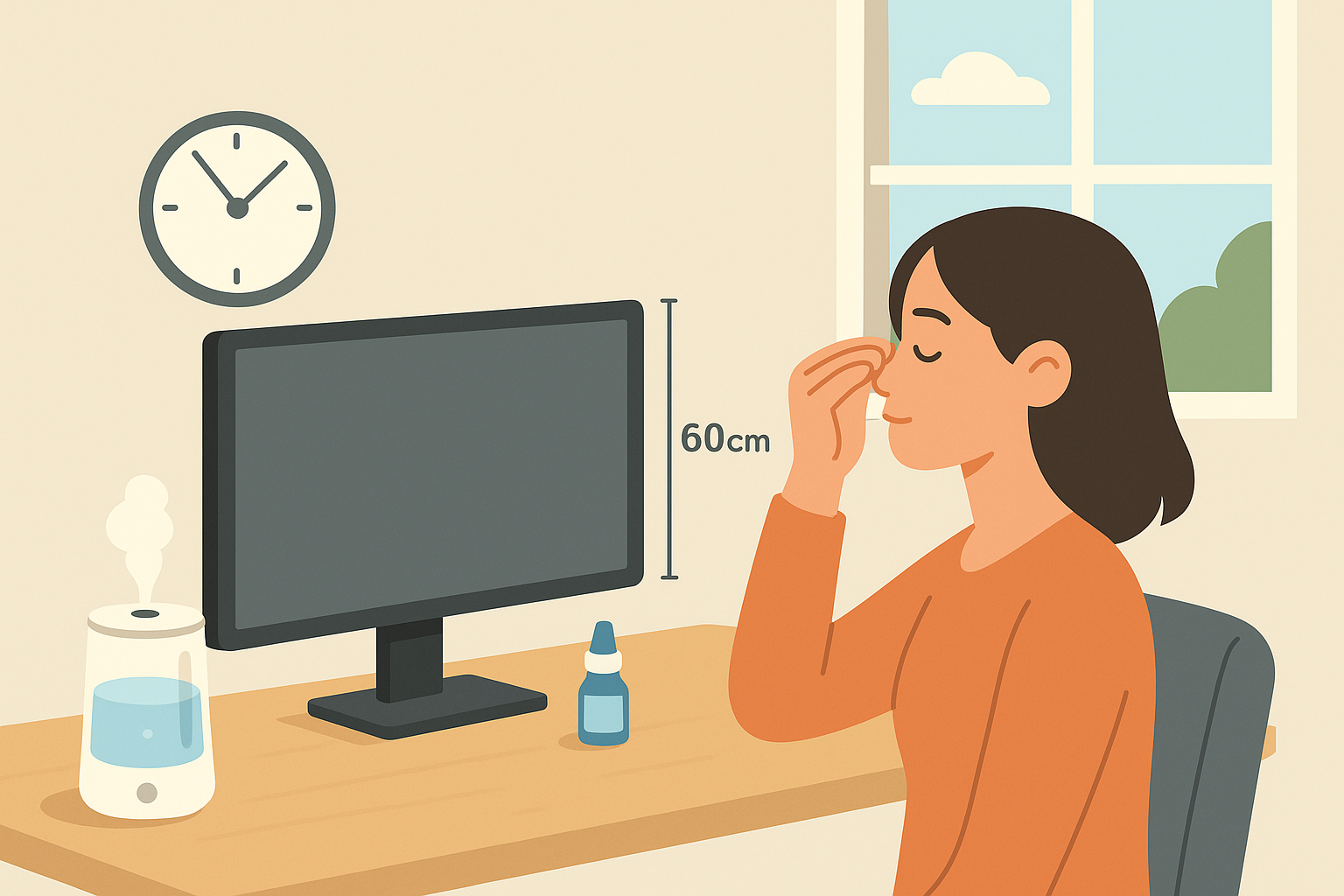
Daily Routine to Reduce Dry Eyes and Eye Fatigue
- Maintain 40–60% Humidity: Use a humidifier or a cup of water on your desk. Avoid directing heater/AC airflow toward your face.
- Warm compress (5–10 minutes): Improves meibomian gland oil fluidity → Stabilizes tear film.
- Eye area stretching (2 minutes):
- Reduce contact lens wear time: Prolonged wear increases dryness and oxygen deprivation. Switch to glasses at home.
Work/Study Environment Setup Checklist
- Monitor 24–27 inches / Resolution 100–120 PPI for optimal front and rear readability.
- When using dual monitors, position the primary monitor directly in front and the secondary monitor at about 30° to the side.
- Use off-white document backgrounds (less glare than pure white).
- Keyboard backlight only when necessary. Keep wrists at a 10–15° angle and frequently relax your shoulders.
- Take a 3-minute window walk after meetings or focused work—resets both eyes and brain.
Nutrition and lifestyle habits are also fuel for your eyes
- Omega-3 (fatty fish): Helps improve dry eye symptoms.
- Frequently consume spinach, kale, and broccoli, rich in lutein and zeaxanthin.
- Also consume vitamin A (carrots, eggs) and vitamins C/E (berries, nuts) in balanced amounts.
- 7 hours of sleep: Sleep deprivation reduces the time for recovery and lubrication of the eyes.
- Reduce smoking and excessive drinking: They negatively impact blood flow and the tear film.
These symptoms are warning signs for an eye exam
- Blurred or hazy vision, uneasiness while driving at night
- Glare or halos, frequent headaches
- Persistent foreign body sensation or burning even after using artificial tears
- If you have diabetes or high blood pressure, or a family history (glaucoma, macular degeneration)
- → Once a year, a comprehensive eye exam (visual acuity, intraocular pressure, dry eye assessment, dilation if needed) is recommended. For presbyopia correction options (multifocal glasses, contacts, surgery) after age 40, consult based on your lifestyle patterns.
In the digital era, perfect avoidance is impossible, but smart usage is possible. Your eyes respond immediately just by maintaining distance, posture, lighting, and the 20-20-20 rule, plus blinking and humidity. Start today by moving your screen 10cm back from your desk and increasing your browser text size by one level. Your next month's eye strain will be different.


댓글